Nano-Phyling
Nano-Phyling
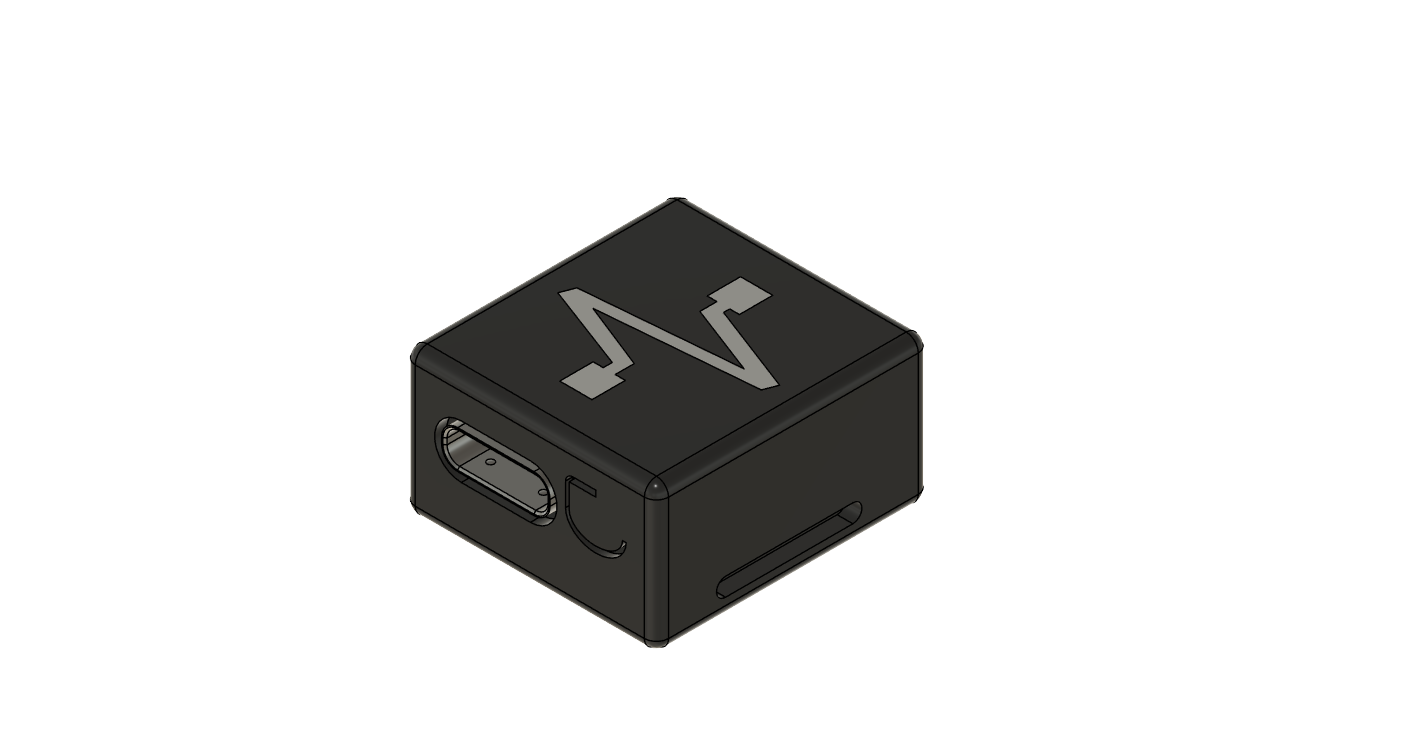
The Nano-Phyling is an ultra-miniature 9-axis IMU designed to democratize motion measurement. It completes the Phyling sensor family with a compact, simple and immediately usable solution.
Overview
Since its creation, Phyling has been developing solutions aimed at making physical data easier to access. The Nano-Phyling is part of this approach, offering an accurate tool for motion analysis, whether in an educational setting or for research, prototyping or application exploration projects.
Thanks to its ultra-miniature form factor and its USB-C and Bluetooth Low Energy (BLE) connectivity, it fits easily into a wide range of environments without heavy infrastructure.
Technical specifications
| Feature | Value |
|---|---|
| Sensors | 9-axis IMU (16G accelerometer, 2000°/s gyroscope, 16 Gauss magnetometer) |
| Dimensions | 22 × 22 × 12 mm |
| Weight | 6 g |
| Connectivity | USB-C, Bluetooth Low Energy (BLE) |
| Battery life | Up to 4 hours of continuous use |
| Transmission | Real time |
| Sampling frequency | 200 Hz |
| Internal storage | No |
Features and Uses
The raw data provided by the Nano-Phyling makes it possible, after processing, to carry out many motion-related analyses:
- Orientation: Analysis of orientation in space (tilt, tipping).
- Motion tracking: Detection, gesture tracking and trajectory computation.
- Frequency analysis: Computation of oscillation frequencies.
- Biomechanics: Counting of steps or cycles.
- Kinematics: Measurement of angular velocities.
The Nano-Phyling is intended for a wide range of users:
- Students and teachers: For hands-on learning (lab sessions, projects).
- Researchers and R&D labs: For experimentation and rapid prototyping.
- Enthusiasts: Fans of applied mathematics and physics.
- Industrial users: To discover and evaluate the possibilities of embedded measurement on existing systems.
Quick start
The Nano-Phyling was designed for immediate software use. It integrates easily into your Phyling environment (Maxi-Phyling, Maxi-Hub) but can just as well connect directly to any computer.
Installing the library
A Python library lets you retrieve the data in just a few lines of code:
pip install phylingPowering on and connecting to the Nano-Phyling
A long press on the Nano-Phyling button turns it on. The green LED blinks 🟢.
Collecting data
The nano.run() command connects to the Nano-Phyling and starts the acquisition of the data sent by the Nano-Phyling. The LED turns blue when recording starts 🔵.
Retrieving data
The recorded data is then stored in a Python table (DataFrame) and is ready to be analyzed.
Example of use: instrumented pendulum lab
To illustrate concretely how the Nano-Phyling is used in an educational setting, a complete lab on the study of an instrumented pendulum is available.
This lab relies on a Python notebook (Jupyter) and provides a progressive introduction to the data coming from the Nano-Phyling.
A dataset recorded with a Nano-Phyling is also provided so that users can visualize the structure of the signals and test the analyses, even without immediate access to the sensor.
This lab covers:
- getting started with the Nano-Phyling,
- the acquisition of inertial data (accelerations, angular velocities),
- the analysis of the oscillating motion of a pendulum from the measured signals,
- the use of the data to link experimental measurements with physical modeling.
It is a representative example of how the Nano-Phyling can be used to teach experimental physics (mechanics, signal processing) and can serve as a basis for lab sessions, student projects or demonstrations.
The lab resources (Jupyter notebook and associated dataset) are available here:
Pendulum lab – Nano-Phyling