PhyLift
PhyLift
Overview
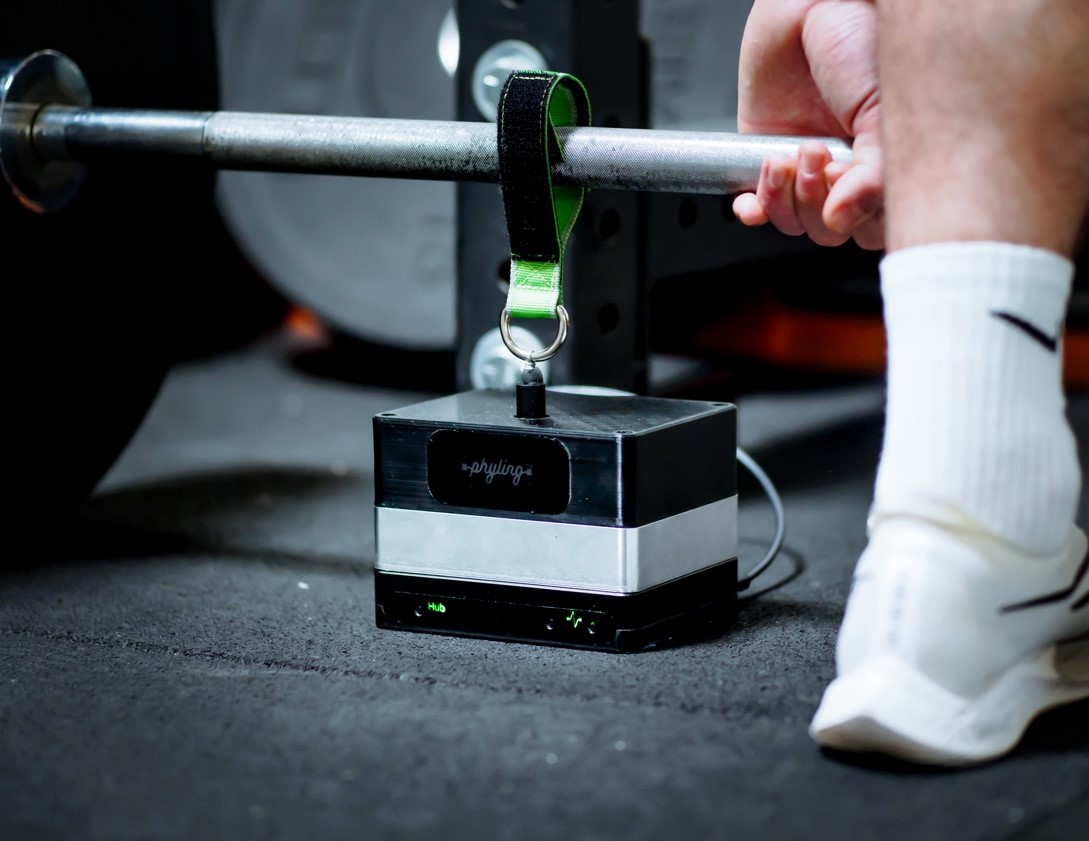
The PhyLift is a measurement tool for strength and conditioning that analyses the speed and power developed during each of your movements. It gives you immediate visual feedback on the execution speed of your movement, so you can work within your target speed zone.
Technical specifications
| Specification | Value |
|---|---|
| Dimensions | 14 cm x 11 cm x 10 cm |
| Weight | 2.2 kg |
| Sampling rate | up to 1 kHz |
The validation paper for the PhyLift sensor is available at: www.phyling.fr/file-share
Using the PhyLift
The PhyLift analyses the speed and power developed during each of your movements. Simply attach it to your bar to get immediate visual feedback on the execution speed of your movement, so you can work within your target speed zone.
Compared with other measurement tools on the market, the PhyLift also lets you calculate your Force-Velocity-Power profile automatically in just a few minutes. In addition to mean velocity data, it also provides the bar displacement profile over the entire movement.
You can use the PhyLift in free recording mode or by following scenarios.
Free recording
You can use the PhyLift with any exercise (squat, bench press, pulls, cable machine…). After completing your repetitions, simply find all your data in the Phyling app (raw data, velocity and displacement curves over your set, etc.).
Force-Velocity Profile scenario
The "Force-Velocity Profile" scenario lets you carry out a force-velocity profile automatically, simply and quickly. Whatever the exercise, enter the loads and the number of repetitions you are going to perform, then do your exercise. At the end, the automatic report provides your force/velocity/power profile along with the associated key indicators (load and velocity at maximal power, etc.).
Example report
Interpreting the results
| Variable | Description |
|---|---|
| Load at Pmax (kg) | Load that allows the theoretical maximal power to be developed |
| Velocity at Pmax (m/s) | Mean velocity of the concentric phase corresponding to the load that allowed the theoretical maximal power to be developed |
Target Velocity scenario
The "Target velocity" scenario lets you work within a precise training zone using real-time feedback. Simply define the target velocity zone (as a percentage of your velocity at maximal power, for example: 95-105%), then perform the desired number of repetitions. At the end of your exercise, an automatic report tells you whether the repetitions were performed at the right velocity and provides the displacement curves of each repetition.
Whatever the exercise, position the PhyLift so that you can perform the full range of motion without obstruction, then attach the strap to the bar/dumbbell/cable. Start the chosen scenario when the bar or cable is in its starting position, then enter the scenario parameters (number of repetitions, athlete name, etc.) and start recording.
Example report
Indicator descriptions
| Indicator name | Description | Unit | Detailed definition |
|---|---|---|---|
| rep | Number of repetitions | Total number of repetitions performed during the test. | |
| plage | Target work range | Target velocity zone. | |
| reussite | Success | Number of repetitions performed within the predefined target velocity range. | |
| vmoy | Mean velocity | m/s | Mean velocity reached during the concentric phase of the repetition. |
| vmax | Max velocity | m/s | Maximal velocity reached during the repetition. |
| distance | Range of motion | cm | Maximal range of motion, measured between the low and high points of the movement. |
| pt_bas | Low point | cm | Lowest position reached by the bar or load, relative to its starting position. |
| pt_haut | High point | cm | Highest position reached by the bar or load, relative to its starting position. |
| motif_id | Trial | Number or identifier of the repetition, allowing individual tracking of trials. |
Technical notes
- The target work range and the success count let you check whether the athlete respects the target velocity instruction during the exercise.
- The mean velocity (vmoy) and maximal velocity (vmax) indicators are essential for assessing the quality of execution and progress over sessions.
- The high (pt_haut) and low (pt_bas) points let you analyse the range and stability of the movements performed.