PhyNord
PhyNord
Overview
The PhyNord is a device dedicated to physical preparation, equipped with force sensors for analysing the "Nordic Hamstring Curl" exercise.
Technical specifications
| Specification | Value |
|---|---|
| Dimensions | 100 cm x 62.5 cm x 63.5 cm |
| Weight | 26 kg |
| Sensors | 1 sensor on each side of the frame (measurement along the normal axis) |
| Sampling rate | up to 1kHz |
The PhyNord validation article is available at: www.phyling.fr/file-share
Nordic scenario
The Nordic Hamstring Curl
Hamstring injuries are prevalent in team sports, particularly those involving high-intensity running and sprinting such as football or rugby. During a sprint, a hamstring injury can occur at the end of the swing phase / beginning of the ground contact phase, when the hamstrings (especially the biceps femoris) are stretched close to their maximum length and contract eccentrically. The "Nordic Hamstring Curl" is an exercise developed to strengthen the eccentric strength capacities of the hamstrings. It has been included in many injury prevention programmes and its beneficial effect has been scientifically proven (Al Attar et al., 2017; Arnason et al., 2008).
The Nordic Hamstring Curl is performed as follows:
- Start on your knees, with your ankles held by another person or by an object
- Keeping your hips still, lower yourself towards the ground as slowly and as far as possible
- Catch yourself with your hands when you can no longer hold your descent, then push back up to the starting position to start the exercise again
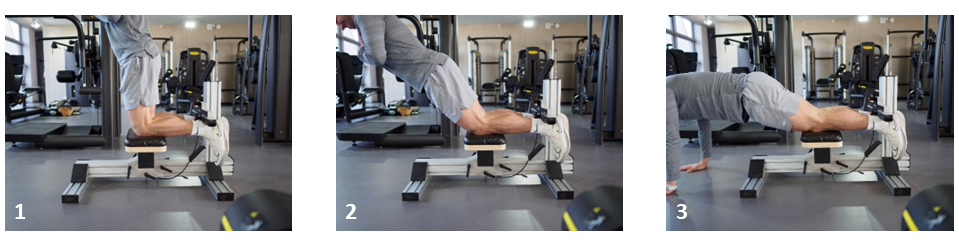
The PhyNord makes it possible to perform this exercise more precisely by measuring the forces developed by each limb throughout the descent. During a trial, the mean and maximum force values for each limb, as well as the percentage of asymmetry between the two legs, are calculated automatically. This provides an assessment of the eccentric muscle capacities of the hamstrings and makes it possible to monitor an athlete's condition throughout the season, before/after a specific training programme or during rehabilitation, for example.
Scenario flow
The predefined scenario with all the steps of the exercise is as follows:
- Setting the scenario parameters (number of repetitions, athlete, etc.)
- Taring the Nordic sensor
- The athlete gets into position
- Performing the n repetitions
- Data analysis and automatic generation of a PDF report
Example report
Description of the indicators
| Indicator name | Description | Unit | Detailed definition |
|---|---|---|---|
| F_max_bw | Max force /BW | Average of the maximum force developed during the repetition, normalised by body weight. | |
| score | Score | % | Performance score calculated according to the athlete's weight (Buchheit et al., 2016). |
| asymetrie | Asymmetry | % | Ratio between the mean force developed by the left leg and the mean force developed by the right leg. |
| F_max | Max force | N | Maximum force developed during the repetition. |
| Fd_max | Max force right | N | Maximum force developed by the right leg during the repetition. |
| Fg_max | Max force left | N | Maximum force developed by the left leg during the repetition. |
| F_moy | Mean force | N | Mean of the total force developed during the repetition. |
Technical notes
The score (score) can be used as an overall performance indicator, taking the athlete's body weight into account for a fair comparison.
Bibliography
- Al Attar, W. S. A., Soomro, N., Sinclair, P. J., Pappas, E., & Sanders, R. H. (2017). Effect of Injury Prevention Programs that Include the Nordic Hamstring Exercise on Hamstring Injury Rates in Soccer Players: A Systematic Review and Meta-Analysis. In Sports Medicine (Vol. 47, Issue 5, pp. 907–916). Springer International Publishing. https://doi.org/10.1007/s40279-016-0638-2
- Arnason, A., Andersen, T. E., Holme, I., Engebretsen, L., & Bahr, R. (2008). Prevention of hamstring strains in elite soccer: An intervention study. Scandinavian Journal of Medicine and Science in Sports, 18(1), 40–48. https://doi.org/10.1111/j.1600-0838.2006.00634.x
- Buchheit, M., Cholley, Y., Nagel, M., & Poulos, N. (2016). The Effect of Body Mass on Eccentric Knee-Flexor Strength Assessed With an Instrumented Nordic Hamstring Device (Nordbord) in Football Players. International Journal of Sports Physiology and Performance, 11(6), 721-726. Retrieved Apr 29, 2024, from https://doi.org/10.1123/ijspp.2015-0513