Stud-E
Stud-E
Introduction
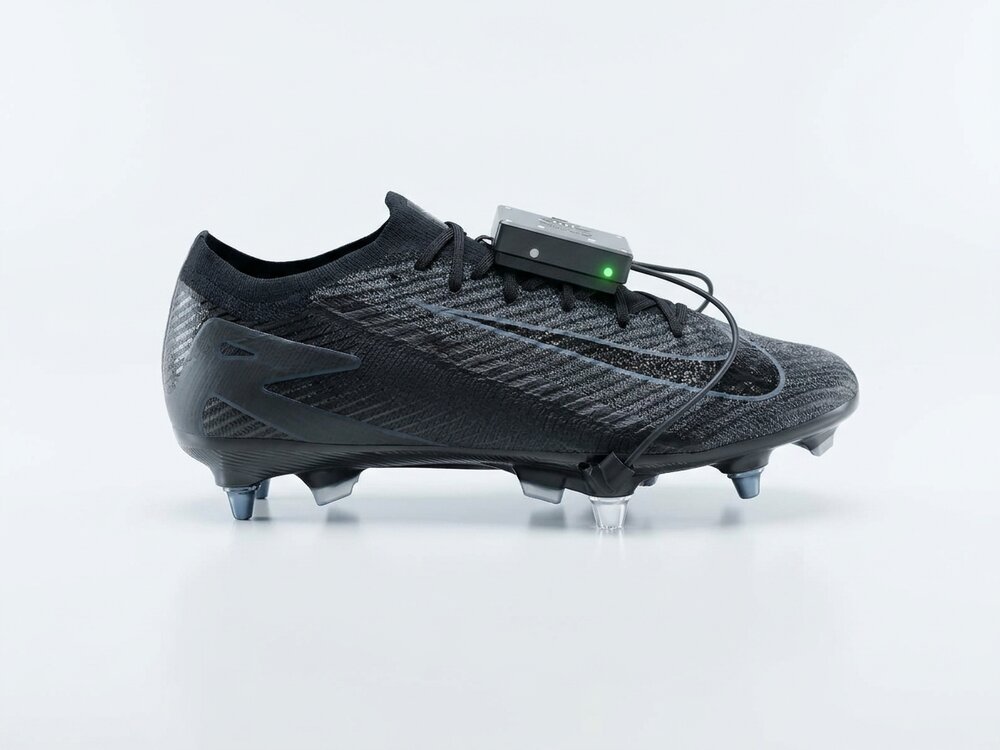
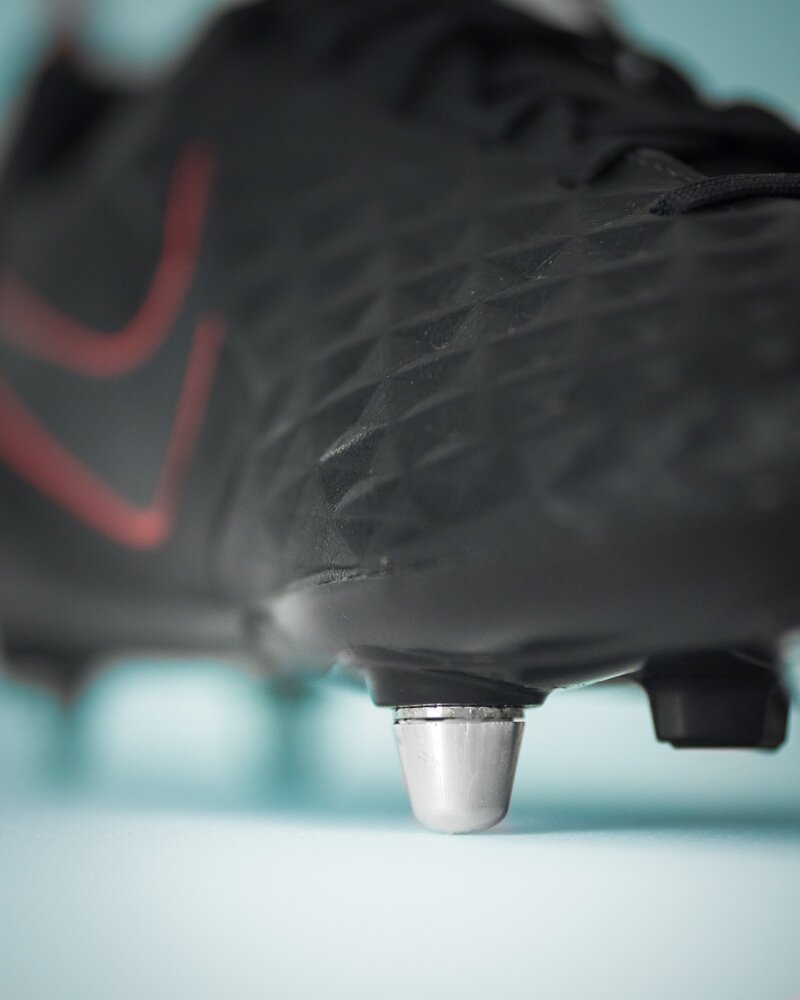
Stud-E are studs instrumented with force sensors. They screw in place of the original studs of a screw-in football or rugby boot and measure the force applied to each stud. Connected to a Mini-Phyling acquisition unit attached to the laces, they measure ground reaction forces directly on the pitch, step by step.
Stud-E are first and foremost a research tool: it is the stud that is instrumented, not the boot. They are used to monitor mechanical load during training or to analyse foot placement.
Main features
| Feature | Value |
|---|---|
| Sensor type | Instrumented stud, uniaxial force sensor (vertical or horizontal) |
| Number of studs | Up to 6 per boot, at the original locations |
| Measurement range | 0 to 1500 N per stud |
| Measurement noise | Around 2 N |
| Accuracy | Around 5% on average (depends on use, context and calibration) |
| Inertial measurement unit | Accelerometer (± 16 G), gyroscope (± 2000 °/s), magnetometer, built into the Mini-Phyling |
| Sampling frequency | Up to 400 Hz per channel, for 6 studs |
| Added mass | 71 g per boot (6 studs + 1 Mini-Phyling) |
| Battery life | 3 h 30 of continuous acquisition |
| Storage | Locally in the Mini-Phyling, for the whole battery life |
| Data transfer | Bluetooth Low Energy (BLE) to the Maxi-Phyling, then Wi-Fi to the cloud |
| Left/right synchronization | ± 10 ms |
| Compatibility | Commercial screw-in football or rugby boots |
| Included accessories | Magnetic charger |
Stud layout
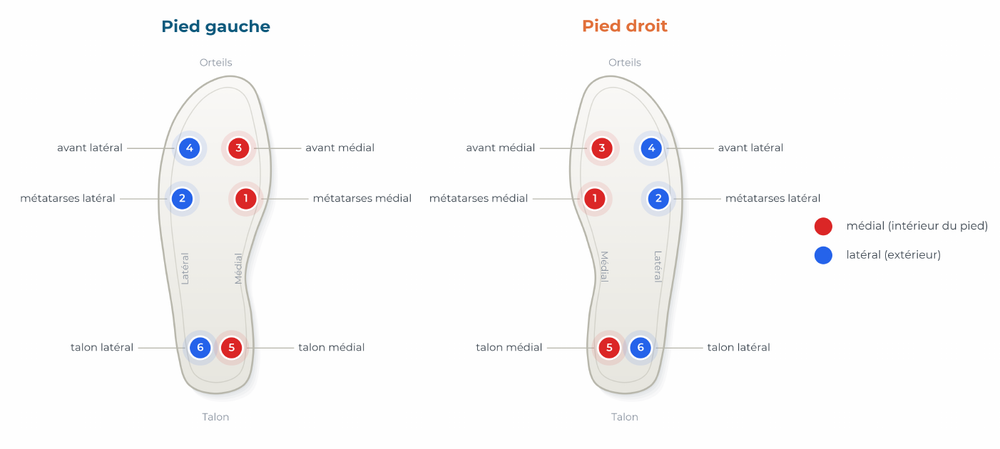
Each boot has six measurement channels, numbered 1 to 6. Odd channels are on the medial side (inside of the foot), even channels on the lateral side (outside).
| Channel | Position |
|---|---|
| 1 | Medial metatarsal |
| 2 | Lateral metatarsal |
| 3 | Medial forefoot |
| 4 | Lateral forefoot |
| 5 | Medial heel |
| 6 | Lateral heel |
System architecture
- The studs are wired to the Mini-Phyling attached to the laces.
- Each Mini-Phyling sends its data over Bluetooth Low Energy to the Maxi-Phyling worn by the person (range: a few metres).
- The Maxi-Phyling transmits over Wi-Fi to the cloud, for real time and data retrieval (range: 20 to 100 m to the Wi-Fi access point depending on the antenna).
Scientific articles
- Scientific validation — Validation of Instrumented Football Shoes to Measure On-Field Ground Reaction Forces. A. Karamanoukian, J.-P. Boucher, R. Labbé, N. Vignais. Sensors 2022, 22, 3673. Validated in the laboratory and then on the pitch, against a force platform. DOI: 10.3390/s22103673
- Thesis — Développement d'un outil de quantification de la charge mécanique en football à partir de crampons instrumentés de capteurs de force : vers une application à la prévention des blessures. PhD thesis of Alexandre Karamanoukian, Université Paris-Saclay, 2023 (in French). Read the thesis on HAL
- Monitoring fatigue-induced ground reaction forces variations among professional football players using an instrumented pair of football shoes: a two-phase study. A. Karamanoukian, J.-P. Boucher, R. Labbé, N. Vignais. Changes in ground reaction forces with fatigue, during an exhaustive run with amateur players and then over a full season with professional players.
- Effects of fatigue on ground reaction forces measured through embedded sensors in football shoes during a constant velocity run: a preliminary study. A. Karamanoukian, J.-P. Boucher, R. Labbé, N. Vignais. Abstract, 46th congress of the Société de Biomécanique.
Find this work on the Publications — Football page.
User guide
I. Fitting the studs
- Remove the original studs from the boot.
- Screw each Stud-E into its location (see Stud layout) while holding the cup, never by pulling on the wire. The weak point is the cable exit: guide the wire during rotation so that it does not twist.
- Attach the Mini-Phyling to the laces and check that the cables do not hinder movement.
- Never use the wire as a lever or as a handle to carry the boot.
II. Calibration
Each pair is calibrated by Phyling on delivery and comes with a calibration certificate.
Calibration method
The coefficients are obtained on a six-sensor ground bench developed by Phyling: each stud is loaded onto a reference sensor, and its law is identified only on the zones where the stud and the reference actually track each other.
Force is obtained from the relation F = coef × (raw signal), with F in N and the raw signal in V. A channel is only retained if:
- its zero is valid and its coefficient positive;
- its coefficient of determination R² is greater than or equal to 0.90;
- its calibrated range is at least 196 N;
- at least 4000 points are retained (i.e. 10 s of load at 400 Hz).
The calibrated range is the one over which the coefficient is guaranteed; beyond it, it is extrapolated. This is why loading as much as possible during calibration is recommended.
Certificate content
For each channel of each boot, the certificate lists: the coefficient (N/V), the offset (V), the R², the measurement range (N), the measurement noise (N) and the channel status (retained or not). Its appendix shows the usable zones and the regressions per channel.
Recalibration
Screwing or unscrewing a stud changes the calibration: the mounting preload changes, and with it both the zero and the coefficient of the channel. Any intervention (removal, retightening, replacement) can therefore change the values of the certificate, which reflects the state of the pair at its recording date. A calibration bench can be supplied to recalibrate the studs regularly.
III. Data recording
For optimal accuracy, switch on the Mini-Phyling units 10 minutes before recording.
Check before each session
On the mobile interface, press each stud in turn and check that all six channels of the foot respond. A silent, saturated or noisy channel most often indicates a loose stud or a bad contact: retighten and check again before starting the acquisition.
Local recording mode
The Mini-Phyling units have internal memory, allowing fully autonomous recording for the whole battery life.
- Press the ON button for half a second to switch on the Mini-Phyling. The green LED lights up.
- Briefly press the REC button to start recording. The LED turns blue. Repeat on each boot.
- Press the REC button again to stop recording. The LED turns green again.
- Export the data by switching the Mini-Phyling to USB mode with a long press on the ON button (Mini-Phyling off), then plug it into a USB port of the computer. The file is in the DATA folder.
Bluetooth recording mode
A Bluetooth (BLE) connection is established between each Mini-Phyling and the Maxi-Phyling worn by the person. The Maxi-Phyling handles the synchronization of both feet (± 10 ms) and sends the data to the cloud for real-time visualization.
- Switch on the Mini-Phyling units and the Maxi-Phyling. The connection is established automatically.
- Press the REC button of the Maxi-Phyling, or start recording from the Real time tab of the Phyling application.
- Press the REC button again to end the recording.
- The Maxi-Phyling automatically sends its data to the Hub.
Charging
Only use the magnetic charger supplied by Phyling. When charging is complete, the charging LED turns off. Do not record while the sensor is plugged in.
IV. After the session
- If necessary, wipe the cup and the stud dry, without water jets or immersion, and let them dry before storage.
- Store the system at room temperature, with a charged battery: the batteries have a small capacity (lifespan of around 2 years) and can be damaged if stored discharged.
V. Data processing
- Associate: in the Data tab, find the recordings associated with an athlete. Unassociated data from a recent recording can be accessed by clicking the NEW button (in blue). Click a recording to associate it.
- Visualize: click an associated recording to view the data, make selections and export the data in
csvformat.
Data
Phyling gives access to the raw data of each stud and of the inertial measurement unit, in csv format. Processed data can be provided on request: total force, force indicators or custom analyses.
| Data | Description | Unit |
|---|---|---|
| Force per stud | Vertical force measured by each of the 6 channels | N |
| Accelerometer | Accelerations along the 3 axes of the Mini-Phyling | G |
| Gyroscope | Angular velocities along the 3 axes of the Mini-Phyling | °/s |
Data can also be accessed through the Phyling API. You own your data; it is hosted in the cloud, and locally if needed.
Conditions of use
Stud-E are handmade, custom-built prototypes from the Phyling workshops in Palaiseau, France. Each pair is unique.
- The system is a research tool: it has been neither designed nor validated for match use.
- It is not waterproof and remains sensitive to impacts.
- Prefer artificial turf. Avoid wet grass, mud and sand as much as possible: water seeps in through the thread and sand gets lodged in the cup, which degrades the contact and makes unscrewing difficult.
- Measurement accuracy may decrease during the last 20 minutes of battery.